Friday, February 11, 2022

Abditosaurus and implications for the paleobiogeography of Late Cretaceous lithostrotians from Europe

Since the 1990s a plethora of titanosaur taxa have been described from the Late Cretaceous (latest Campanian-Maastrichtian) of northeastern Spain and southern France (which constituted the Ibero-Armorican island during the latest Cretaceous) as well as Transylvania, Romania, adding to the hitherto described taxa Hypselosaurus from the Provence region of southern France and Magyarosaurus from Transylvania, Romania. Until recently, however, the interrelationships of lithostrotian taxa from the Late Cretaceous of Europe was not tested within a cladistic framework, with most published cladistic studies including only Ampelosaurus and Lirainosaurus (see cited references in Díez Díaz et al. 2018). The cladistic analysis of Sallam et al. (2018) resolved Ampelosaurus, Lirainosaurus, Lohuecotitan, and Paludititan as saltasaurids closely related to Mansourasaurus from the Late Cretaceous of Egypt, implying a geographic dispersal of some lithostrotians from southern Europe into North Africa during the Late Cretaceous. Meanwhile, a cladistic analysis by Díez Díaz et al. (2018) found AmpelosaurusAtsinganosaurus, and Lirainosaurus to form a distinct clade within Saltasauridae that they named Liranosaurinae, whereas the taxa Lohuecotitan and Paludititan were resolved as more derived than the basalmost lithostrotian Malawisaurus but cladistically more primitive than derived lithostrotians. This week, another new lithostrotian titanosaur from the latest Cretaceous of southern Europe came hot off the press, named Abditosaurus kuehnei (Vila et al. 2022), and instead of being a dwarf, insular taxon, it surprisingly happens to be a giant for its time and geographical location. Therefore, this post will discuss the implications of Abditosaurus for the paleobiogeography of lithostrotians from the latest Cretaceous of Europe.

Walter Georg Kühne (1911–1991), the discoverer of the holotype of Abditosaurus kuehnei

As noted by Vila et al. (2022; supplementary material), the history of the discovery of the holotype of  Abditosaurus kuehnei is rather lengthy and tortuous, hampered by funding issues and bad weather. In September 1954, German paleontologist Walter Georg Kühne, an expert on Mesozoic mammals from Europe and worldwide, prospected Cretaceous outcrops west of the village of Orcau in the Tremp Basin of Catalonia, Spain, with the goal of finding Cretaceous mammal fossils when he unexpectedly found fossils of a titanosaur sauropod. For the next two weeks (September 27 to October 5), he unearthed ten bones at the Orcau-1 site, of which two chevrons, a right tibia, and a distal left femur were collected and sent to the Instituto Lucas Mallada (ILM, now Museo Nacional de Ciencias Naturales [MNCN]) in Madrid, and other remains (e.g. proximal left femur, left humerus, two articulated dorsal vertebrate) were left at the site. Kühne returned to the Orcau-1 site and excavated a complete right femur and humerus, a distal left fibula, the anterior end of a left scapula, a chevron, an indeterminate “short” bone, a few small iliac fragments, a complete dorsal vertebra, and fragments of three dorsal ribs, which were also sent to the ILM. He requested additional excavations at the Orcau-1 site, but a lack of funds caused field work at the locality to be shelved. Lapparent and Aguirre (1956, 1957) considered the titanosaur material from the Orcau-1 site to be a probable new species of the genus Hypselosaurus Matheron, 1869 (now considered a nomen dubium; Le Loeuff 1993). In 1984 and 1986 Josep Vicenç Santafé of the Institut de Paleontologia de Sabadell in Barcelona and members of the Institut d’Estudis Ilerdencs in Lleida revisited the Orcau-1 locality; the 1986 expedition, which lasted for five days, unearthed part of a sternal plate and three dorsal ribs (of which one, MCD-6985, was collected and deposited in the Museu de la Conca Dellà). From 2012 to 2014, members from the Institut Català de Paleontologia, the Universidad de Zaragoza, and the Museu de la Conca Dellà conducted six consecutive expeditions to the Orcau-1 site, unearthing the remaining axial and appendicular remains from the locality and the remains left at the site by Kühne and Santafé, including an articulated cervicodorsal series, additional limb and pectoral girdle remains, tooth fragments, and ribs, all of which were sent to the MNCN. The chevrons (MNCN 59295, MNCN 59539, and MNCN 62760) and humerus (MNCN 79834) unearthed by Kühne were assigned to Titanosauriformes indet. and Titanosauria indet. respectively by Martín Jiménez et al. (2017). The cervicodorsal series of the holotype of Abditosaurus kuehnei constitutes the most complete neck for any titanosaur described from the latest Cretaceous of Europe given that complete or nearly complete necks have been described for very few sauropod specimens (Taylor 2022). 
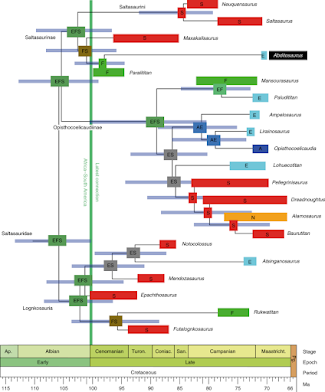
Phylogenetic analysis of Abditosaurus kuehnei and other derived lithostrotian taxa (after Vila et al. 2022)

In their phylogenetic analysis of Titanosauria, Vila et al. recover Abditosaurus as the sister taxon of the Paralititan from the middle Cretaceous (Cenomanian) of Egypt within Saltasaurinae sensu Gorcsak & O'Connor (2019), while Ampelosaurus, Lirainosaurus, Lohuecotitan, and Paludititan are recovered within Opisthocoelicaudiinae and Atsinganosaurus is placed within Lognkosauria as the sister taxon of Notocolossus. Because Sallam et al. (2018) recover all lithostrotian taxa from the Late Cretaceous of Europe except Atsinganosaurus within the same clade as Mansourasaurus, the cladistic analysis by Vila et al. (2022) suggests that more than large/medium-size lithostrotian clade dispersed into Europe from Africa, as Paludititan and Mansourasaurus are recovered by Vila et al. (2022) in a basal position to a clade formed by Ampelosaurus, Lirainosaurus, Lohuecotitan, and the South American taxa Baurutitan, Dreadnoughtus, and Pellegrinisaurus within Opisthocoelicaudiinae sensu Gorcsak & O'Connor. The notion of some Gondwanan tetrapod groups dispersing into the Europe during the late Cretaceous is not new; the assignment of the crocodyliform Doratodon carcharidens to the predominantly Gondwanan clade Notosuchia shows that some notosuchians immigrated to Europe from North Africa (Rabi and Sebők 2015), while abelisauroids are represented in the Late Cretaceous of France by Arcovenator and Tarascosaurus (see Tortosa et al. 2014). Since Opisthocoelicauda is resolved as more closely related to some of the taxa included in Lirainosaurinae by Díez Díaz et al. (2018) than to either Paludititan or Mansourasaurus, and Wang et al. (2021) recover the East Asian taxa Abdarainurus and Huabeisaurus as sister to the basal titanosaur Andesaurus from the middle Cretaceous (Cenomanian) of Argentina, it's reasonable to assume that two lineages of large/medium-bodied lithostrotians dispersed into Europe from Gondwana during Late Cretaceous because Normanniasaurus from the middle Cretaceous (Albian) of northern France and Volgatitan from the Early Cretaceous (Hauterivian) of European Russia are recovered as sister to Colossosauria by Averianov & Efimov (2018) and Mannion et al. (2019), while Mocho et al. (2019) recover two indeterminate titanosaur specimens from the late Aptian-Cenomanian of Spain and Italy as more closely related to Rapetosaurus than to Colossosauria.    

When comparing the results of the cladistic analysis by Vila et al. (2022) to the phylogenetic results obtained by Díez Díaz et al. (2018), I should emphasize that the difference between the two studies in terms of the phylogenetic placement of Lohuecotitan and Paludititan relative to the taxa included in Lirainosaurinae by Díez Díaz et al. is best explained by the huge amount of missing data for the cranial and cervical vertebral characters for several Late Cretaceous titanosaur taxa from Europe in the data matrix employed for the Díez Díaz et al. (2018) analysis, the number of non-European lithostrotian taxa selected for the cladistic analysis, and the fact that the recovery of Nemegtosaurus as the sister taxon to Rapetosaurus in several phylogenies (e.g. Wilson 2002) is now known to be artificial because more than one clade of lithostrotians had a Rapetosaurus-like skull. Given that the Abditosaurus kuehnei holotype preserves the only complete or near-complete neck for any Late Cretaceous titanosaur from the western Tethyan archipelago, and unpublished cladistic results concur with Vila et al. (2022) in recovering Lohuecotitan and Paludititan as part of the same lithostrotian clade as Mansourasaurus and Opisthocoelicauda, it is possible that currently undescribed titanosaur specimens from the Lo Hueco locality could shed new light on the cervical morphology of taxa assigned to Lirainosaurinae. For one thing, Atsinganosaurus is recovered as sister to Ampelosaurus and Lirainosaurus by Díez Díaz et al. (2018) but falls as sister to Colossosauria in the Vila et al. (2022), and because Díez Díaz et al. (2018) note that material referred to Atsinganosaurus by Garcia et al. (2010) was not found articulated or associated with the A. velauciensis holotype (comprising four posterior dorsal vertebrae), it is possible that some of the specimens referred to this taxon might instead belong to Abditosaurus

In summary, more than one clade of large- and medium-sized lithostrotian titanosaurs immigrated to Europe from Gondwana during the Late Cretaceous, gradually supplanting dwarf, insular genera like Magyarosaurus by the latest Maastrichtian. Although insular dwarfism is prevalent among some lithostrotian taxa from the Late Cretaceous of Europe, the size estimates and phylogenetic position for Abditosaurus demonstrate that the environment of the Ibero-Armorican Island most likely did not pose an ecological obstacle to giant titanosaurs dispersing from Gondwana because titanosaur specimens from the middle Cretaceous of Italy and Spain and phylogenetic affinities of Normanniasaurus to colossosaurians indicate that multiple lithostrotian clades dispersed into Europe by the Albian. Future discoveries and re-evaluation of lithostrotian titanosaur specimens currently seen as indeterminate may further shed light the palebiogeographic patterns of lithostrotians from the Late Cretaceous of Europe.   

References:

Averianov, A., and V. Efimov, 2018. The oldest titanosaurian sauropod of the Northern Hemisphere.  Biological Communications 63(6):145–162. doi:10.21638/spbu03.2018.301.

Díez Díaz, V., Garcia, G., Pereda-Suberbiola, X., Jentgen-Ceschino, B., Stein, K., Godefroit, P., and Valentin, X., 2018. The titanosaurian dinosaur Atsinganosaurus velauciensis (Sauropoda) from the Upper Cretaceous of southern France: New material, phylogenetic affinities, and palaeobiogeographical implications. Cretaceous Research91: 429–456. doi:10.1016/j.cretres.2018.06.015

Garcia, G., Amico, S., Fournier, F., Thouand, E., and Valentin, X., 2010. A new titanosaur genus (Dinosauria, Sauropoda) from the Late Cretaceous of southern France and its paleobiogeographic implications. Bulletin de la Societe Geologique de France 181(3):269–277.

Gorscak, E., and O’Connor, P.M., 2019. A new African titanosaurian sauropod dinosaur from the middle Cretaceous Galula Formation (Mtuka Member), Rukwa Rift Basin, southwestern Tanzania.  PLoS ONE 2 (14): e0211412. doi:10.1371/journal.pone.0211412 

Lapparent, A. F. de, and Aguirre, E. S. J., 1956. Algunos yacimientos de Dinosaurios en el Cretacico Superior de la Cuenca de Tremp. (Prov. de Leirida, Espana). Estud. Geol. Inst. Invest. Lucas Mallada 12 (31-32): 37-382.

Lapparent, A. F. de, and Aguirre, E. S. J., 1957. Presence de Dinosauriens dans le Cretace superieur du bassin de Tremp (province de Lerida, Espagne). Compte rendu sommaire des seances de la Societe de Geologie, France 1956: 261-262.

Le Loeuff, J., 1993. European titanosaurids. Revue de Paléobiologie, Volume Spéciale 7:105-117.

Mannion, P. D., Upchurch, P., Jin, X., and Zheng, W., 2019. New information on the Cretaceous sauropods of Zhejiang Province, China: impact on Laurasian titanosauriform phylogeny and biogeographyRoyal Society Open Science 6(8):191057. doi:10.1098/rsos.191057.

Martín Jiménez, M., Sánchez-Chillón, B., Escaso, F., Mocho, P., Narváez, I., Ortega, F., and Pérez-García, A., 2017. Systematic study of the historical material of Upper Cretaceous reptiles from the Tremp Basin (Catalonia, Spain) housed at the Museo Nacional de Ciencias Naturales (Madrid). Journal of Iberian Geology 43(2): 217-233. 

Mocho, P., A. Pérez-García, M. Martín Jiménez, and F. Ortega, 2019. New remains from the Spanish Cenomanian shed light on the Gondwanan origin of European Early Cretaceous titanosaurs. Cretaceous Research 95:164–190. doi:10.1016/j.cretres.2018.09.016.

Rabi, M., and Sebők, N., 2015. A revised Eurogondwana model: Late Cretaceous notosuchian crocodyliforms and other vertebrate taxa suggest the retention of episodic faunal links between Europe and Gondwana during most of the Cretaceous. Gondwana Research28 (3): 1197–1211.  doi:10.1016/j.gr.2014.09.015

Sallam, H., Gorscak, E., O'Connor, P., El-Dawoudi, I., El-Sayed, S., Saber, S., 2018. New Egyptian sauropod reveals Late Cretaceous dinosaur dispersal between Europe and Africa. Nature 2 (3): 445–451. doi:10.1038/s41559-017-0455-5

Taylor, M., 2022. Almost all known sauropod necks are incomplete and distortedPeerJ 10:e12810  .

Tortosa, T., Buffetaut, E., Vialle, N., Dutour, Y., Turini, E., and Cheylan, G., 2014. A new abelisaurid dinosaur from the Late Cretaceous of southern France: Palaeobiogeographical implications. Annales de Paléontologie 100(1): 63-86.

Vila, B., Sellés, A., Moreno-Azanza, M., Razzolini, N.L., Gil-Delgado, A., Canudo, J.I., and Galobart, A., 2022. A titanosaurian sauropod with Gondwanan affinities in the latest Cretaceous of EuropeNature Ecology & Evolution 6: 288-296. doi:10.1038/s41559-021-01651-5.

Wang, X., K. L. N. Bandeira, R. Qiu, S. Jiang, X. Cheng, Y. Ma, and A. W. A. Kellner. 2021. The first dinosaurs from the Early Cretaceous Hami Pterosaur Fauna, ChinaScientific Reports 11:14962. doi:10.1038/s41598-021-94273-7.

Wilson, J.A., 2002. Sauropod dinosaur phylogeny: critique and cladistic analysisZoological Journal of the Linnean Society 136 (2): 215–275.

Saturday, December 18, 2021

Critical analysis of the Navarro (2019) thesis regarding Tapuiasaurus

A titanosaur specimen (MZSP-PV 807) from the Early Cretaceous (late Barremian-early Aptian) Quiricó Formation in Minas Gerais, southeastern Brazil was described as the holotype of the new genus and species Tapuiasaurus macedoi by Zaher et al. (2011). In the original description (focused solely on the skull), Zaher et al. recovered this taxon as a member of Nemegtosauridae sensu Wilson (2002), but the cladistic placement of Tapuiasaurus as sister to Nemegtosaurus rather than Rapetosaurus created a 55 million year ghost lineage, and Poropat et al. (2015) recovered Rapetosaurus as a sister taxon of Isisaurus within Saltasauridae and Nemegtosaurus as more basal among advanced lithostrotians, indicating that cranial characters cited as diagnostic for Nemegtosauridae by Wilson (2002) occur in more than one lithostrotian clade. Wilson et al. (2016) provided a more detailed description of the skull of the Tapuiasaurus macedoi, and utilizing new morphological data, they re-analyzed the cladistic position of Tapuiasaurus and found it to be extremely labile, further confirming that Tapuiasaurus was not as closely related to Nemegtosaurus as previously thought. Meanwhile in their description of the lithostrotian Sarmientosaurus from Argentina, Martinez et al. (2016) also recovered Tapuiasaurus as distantly related to Nemegtosaurus. In an unpublished thesis describing of the postcranial skeleton of Tapuiasaurus, Navarro (2019) agrees with Wilson et al. (2016) that Tapuiasaurus is distantly related to Nemegtosaurus, but finds Tapuiasaurus to fall in a more basal position within Lithostrotia along with Isisaurus and Rapetosaurus. Given that the inter-relationships among derived titanosaurs are still a work in progress despite recent advances, I will allow the main findings of the phylogenetic analysis of Tapuiasaurus by Navarro (2019) and their implications for lithostrotian macroevolution do the talking, especially in light of the recent paper by Poropat et al. (2021) recovering Sarmientosaurus outside Lithostrotia as the sister taxon of Diamantinasaurus.

Skull of the holotype of Tapuiasaurus macedoi (MZSP-PV 807) (after Zaher et al. 2011)

In the cladistic analysis in part 4 of his thesis (titled "Results"), Navarro (2019) recovers Tapuiasaurus as the sister taxon of the East Asian taxon Yongjinglong and an unnamed lithostrotian titanosaur from the Adamantina Formation of the Prata municipality in southeastern Brazil, with all three taxa forming a clade sister to Isisaurus and Rapetosaurus. He erects the nomen ex dissertationae "Tapuiasaurinae" to include Tapuiasaurus, Yongjinglong, the Prata titanosaur, and probably Gobititan, and the clade formed by "Tapuiasaurinae", Isisaurus, and Rapetosaurus falls as phylogenetically intermediate between the most basal lithostrotians (Malawisaurus and Rukwatitan) from East Africa and the most derived lithostrotians (Eutitanosauria sensu Navarro 2019). The recovery of Isisaurus and Rapetosaurus as outside Saltasauridae (contra Poropat et al. 2015) adds a new twist in understanding lithostrotian macroevolution, because their placement as sister to "Tapuiasaurinae" would imply that more than one clade of lithostrotian titanosaurs acquired Nemegtosaurus/Rapetosaurus-like cranial features by the Aptian-Albian interval, since Yongjinglong hails from the Aptian-Albian upper part of the Hekou Group of northern China, and hence temporally intermediate between Tapuiasaurus and RapetosaurusYongjinglong itself was originally described as an opisthocoelicaudiine saltasaurid by Li et al. (2014) but was recovered outside Titanosauria as a euhelopodid by Mannion et al. (2019). Although the vast majority of colossosaurian titanosaurs are based on specimens that include no skull material, a recent paper by Averianov et al. (2021) recovering the Early Cretaceous (Hauterivian) genus Tengrisaurus as a relative of Colossosauria suggests that both saltasaurids and non-saltasaurids diverged from the most basal lithostrotians and the Isisaurus+Rapetosaurus+"Tapuiasaurinae" clade by the Hauterivian, in which case complete skull material for many colossosaurian taxa is required to determine how the cranial anatomy of colossosaurians compares to that of saltasaurids, Rapetosaurus and Tapuiasaurus. 

With respect to the systematic paleontology section of Chapter 1 in Navarro's (2019) thesis, the genera Adamantisaurus, Arrudatitan, and Trigonosaurus are grouped together in a distinct clade that is sister to Rinconsauria, dubbed "Trigonosaurinae". However, Aeolosaurus and Gondwanatitan are not included by Navarro in his cladistic analysis even though he offers a stem-based definition for Aeolosaurini (under which only Aeolosaurus and Gondwanatitan are included), and cladistic analyses by França et al. (2016), Hechenleitner et al. (2020), Silva et al. (2021), and Soto et al. (2022)  recover these genera as closely related to the taxa included by Navarro (2019) in Rinconsauria and "Trigonosaurinae", with the latter two papers grouping Trigonosaurus with Bravasaurus, Gondwanatitan, and Uberabatitan  rather than Aeolosaurus and Arrudatitan. Since the thesis by Navarro (2019) is unpublished, and the holotype of Aeolosaurus rionegrinus is less complete than that of Gondwanatitan faustoi, the proposed clade "Trigonosaurinae" is best treated with a high level of caution, considering that the material preserved in the holotype of Adamantisaurus (MUGEO 1282) is far less substantial than that of Arrudatitan and Trigonosaurus.

In his discussion of the comparisons of the postcranial skeleton of Tapuiasaurus with other titanosaurs, Navarro notes that the manus of the Tapuiasaurus macedoi holotype differs from that described for the Australian titanosaur Diamantinasaurus in having manual phalanges in the first metacarpal (unlike the 2-2-2-2-2 phalangeal formula described for Diamantinasaurus), while noting that Opisthocoelicauda has a manus with reduced ossified phalanges (see Poropat et al. 2015). Although he notes that the vast majority of titanosaur taxa do not preserve manual material, he interprets the phalangeal formula of Tapuiasaurus as reflective of a gradual reduction of the manus as a derived condition for titanosaurs more derived than Andesaurus and Diamantinasaurus. The holotype of Savannasaurus elliotorum, which hails from the same geologic unit and location as Diamantinasaurus, also has the phalangeal formula of Diamantinasaurus (Poropat et al. 2016). Although Diamantinasaurus and Savannasaurus are recovered in a distinct titanosaur clade (Diamatinasauria) outside Lithostrotia as more derived than Andesaurus rather than sister taxa of Andesaurus as in Navarro (2019), and no phalangeal remains are known for Andesaurus or Ninjatitan, the phylogenetic placement of Tapuiasaurus by Navarro (2019) is apparently consistent with Navarro's conclusion that the most primitive titanosaurs retained a 2-2-2-2-2 phalangeal formula. Likewise, Navarro (2019) notes that the pes of Tapuiasaurus differs from derived lithostrotians like Alamosaurus, Mendozasaurus, and Opisthocoelicauda in having 10 phalanges (as does Gobititan), concluding that Tapuiasaurus exhibits a combination of a gradually reduced manus and a pes with 10 phalanges (reduced in more derived lithostrotians).

References:

Averianov, A. O., Sizov, A. V., and Skutschas, P. P., 2021. Gondwanan affinities of Tengrisaurus, Early Cretaceous titanosaur from Transbaikalia, Russia (Dinosauria, Sauropoda). Cretaceous Research 122:104731. doi:10.1016/j.cretres.2020.104731

França, M.A.G., Marsola, J.C.d.A., Riff, D., Hsiou, A.S., and Langer, M.C., 2016. New lower jaw and teeth referred to Maxakalisaurus topai (Titanosauria: Aeolosaurini) and their implications for the phylogeny of titanosaurid sauropods. PeerJ 4:e2054. doi:10.7717/peerj.2054

Hechenleitner, E.M., Leuzinger, L., Martinelli, A.G., Rocher, S., Fiorelli, L.E., Taborda, J.R.A., and Salgado L., 2020. Two Late Cretaceous sauropods reveal titanosaurian dispersal across South America. Communications Biology 3(1):622. doi: 10.1038/s42003-020-01338-w.

Li, L.G., Li, D.Q., You, H.L., and Dodson, P., 2014. A New Titanosaurian Sauropod from the Hekou Group (Lower Cretaceous) of the Lanzhou-Minhe Basin, Gansu Province, ChinaPLOS ONE 9 (1): e85979. doi:10.1371/journal.pone.0085979

Mannion, P.D., Upchurch, P., Jin, X., and Zheng, W., 2019. New information on the Cretaceous sauropod dinosaurs of Zhejiang Province, China: impact on Laurasian titanosauriform phylogeny and biogeographyRoyal Society Open Science 6(8): 191057. doi:10.1098/rsos.191057

Martínez, R. D. F., M. C. Lamanna, F. E. Novas, R. C. Ridgely, G. A. Casal, J. E. Martínez, J. R. Vita, and L. M. Witmer. 2016. A basal lithostrotian titanosaur (Dinosauria: Sauropoda) with a complete skull: implications for the evolution and paleobiology of Titanosauria. PLoS ONE 11(4):e0151661. doi:10.1371/journal.pone.0151661.

Navarro, B. A. 2019. Postcranial osteology and phylogenetic relationships of the Early Cretaceous titanosaur Tapuiasaurus macedoi Zaher et al. 2011. Master's dissertation. Instituto de Biociências da Universidade de São Paulo, São Paulo, Brazil.

Poropat, S.F., Upchurch, P., Mannion, P.D., Hocknull, S., Kear, B.P., Sloan, T., Sinapius, G.H.K., and Elliott, D.A., 2015. Revision of the sauropod dinosaur Diamantinasaurus matildae Hocknull et al. 2009 from the mid-Cretaceous of Australia: implications for Gondwanan titanosauriform dispersalGondwana Research27 (3): 995–1033. 

Poropat, S.F., Mannion, P.D., Upchurch, P., Hocknull, S.A., Kear, B.P., Kundrát, M., Tischler, T.R., Sloan, T., Sinapius, G.H.K., Elliott, J.A., and Elliott, D.A., 2016. New Australian sauropods shed light on Cretaceous dinosaur palaeobiogeography. Scientific Reports 6: 34467. doi:10.1038/srep34467

Poropat S. F., Kundrát M., Mannion P. D., Upchurch P., Tischler T. R., and Elliott D. A., 2021. Second specimen of the Late Cretaceous Australian sauropod dinosaur Diamantinasaurus matildae provides new anatomical information on the skull and neck of early titanosaurs. Zoological Journal of the Linnean Society 192 (2): 610–674.

Silva, J.C., Jr., Martinelli, A.G., Iori, F.V., Marinho, T.S., Hechenleitner, E.M., and Langer, M.C., 2021. Reassessment of Aeolosaurus maximus, a titanosaur dinosaur from the Late Cretaceous of Southeastern Brazil. Historical Biology: An International Journal of Paleobiology. in press.  doi:10.1080/08912963.2021.1920016.

Soto, M., Montenegro, F., Mesa, V., and Perea, D., 2022. Sauropod (Dinosauria: Saurischia) remains from the Mercedes and Asencio formations (sensu Bossi, 1966), Upper Cretaceous of Uruguay. Cretaceous Research 131: 105072. doi:10.1016/j.cretres.2021.105072

Wilson, J.A., 2002. Sauropod dinosaur phylogeny: critique and cladistic analysis. Zoological Journal of the Linnean Society 136(2): 215–275.

Wilson, J. A., D. Pol, A. B. Carvalho, and H. Zaher. 2016. The skull of the titanosaur Tapuiasaurus macedoi (Dinosauria: Sauropoda), a basal titanosaur from the Lower Cretaceous of Brazil. Zoological Journal of the Linnean Society 178(3):611–662.

Zaher, H., D. Pol, A. B. Carvalho, P. M. Nascimento, C. Riccomini, P. Larson, R. Juarez-Valieri, R. Pires-Domingues, N. J. da Silva, Jr., and D. de Almeida Campos. 2011. A complete skull of an Early Cretaceous sauropod and the evolution of advanced titanosaurians. PLoS ONE 6(2):e16663. doi:10.1371/journal.pone.0016663.

Sunday, August 15, 2021

Implications of Hamititan and Silutitan for somphospondyl macroevolution in Early-Middle Cretaceous of East Asia

Over the past two decades, numerous somphospondyl sauropod taxa have been described from the Early-Middle Cretaceous of East Asia (Dong et al. 2001; Mannion et al. 2019), augmenting the previously described taxa Euhelopus zdanskyi (Wiman, 1929), Asiatosaurus mongoliensis Osborn, 1924, Mongolosaurus haplodon Gilmore, 1933, and Asiatosaurus kwangshiensis Hou, Yeh, and Zhao, 1975, in terms of illuminating somphospondyl evolution in the Far East during the first 45 million years of the Cretaceous. However, the fossil record of East Asian titanosaurian taxa from the Berriasian-Albian has for the most part remained patchy and sparse compared to the multitude of euhelopodids from the region, and this is one special reason why titanosaur interrelationships are still a work in progress despite advances towards understanding the cladistic diversity of lithostrotian titanosaurs. Wang et al. (2021) have recently described two new somphospondylian taxa from the Early Cretaceous (early Barremian-early Aptian) Shengkinkou Formation of Xinjiang, the euhelopodid Silutitan sinensis and the titanosaur Hamititan tianshanensis, constituting one of the first instances of euhelopodids and titanosaurs being coeval in the Berriasian-Barremian of East Asia. Hence, it should be worth discussing the implications of Hamititan for the macroevolution of titanosaurs in East Asia during the early to middle Cretaceous.  

Cladogram (using Mannion et al. 2019 dataset) showing the positions of Hamititan and Silutitan (after Wang et al. 2021) 

To begin with, the cladistic analyses conducted by Wang et al. for Hamititan and Silutitan, especially with respect to the datasets from Mannion et al. (2019), offer some new insights into somphospondyl evolution in East Asia during the Early Cretaceous. The most noteworthy aspect of the strict consensus cladogram in figure 8 where Hamititan and Silutitan are treated as distinct operational taxonomic units (OTUs) is the recovery of Hamititan as a derived lithostrotian closely related to Aeolosaurus and Rapetosaurus, more derived than Nemegtosaurus, Tapuiasaurus, and Xianshanosaurus. Regardless of a spree of cladistic studies by Poropat et al. (2015), Wilson et al. (2016), and Carballido et al. (2017) whereby Nemegtosauridae sensu Zaher et al. (2011) is recovered as paraphyletic/polyphyletic in part due to the widespread distribution of putative cranial synapomophies of Nemegtosauridae among different lithostrotian lineages, the cladistic composition of derived Lithostrotia as per Wang et al. with a Nemegtosaurus+Tapuiasaurus+Xianshanosaurus sister to a larger clade formed by titanosaur taxa currently assigned to Saltasauridae and Aeolosaurini would indicate that derived titanosaurs were widespread in Eurasia by the Hauterivan-early Aptian, as indicated by the colossosaurian affinities of Tengrisaurus and Volgatitan from the Hauterivian and Barremian-early Aptian of Russia respectively (Averianov and Efimov 2018; Averianov et al. 2021) and the lithostrotian nature of NHMUK R5333, a specimen comprising a few caudal vertebrae from the Barremian-age Wessex Formation of the Isle of Wight in southern England (Upchurch et al. 2011). Given that Ninjatitan hails from the Berriasian-Valanginian Bajada Colorada Formation of Argentina and indicates a probable Gondwanan origin for Titanosauria (Gallina et al, 2021), it is possible that derived titanosaur clades spread from Gondwana into Eurasia by the Hauterivan-Barremian because Hamititan has strongly procoelous middle caudal vertebrae as in all derived titanosaurs. However, the placement of Hamititan as sister to Aeolosaurus and Rapetosaurus creates a ghost lineage within Lithostrotia, as Hamititan is much older than either  Aeolosaurus or Rapetosaurus. It is therefore possible that future study could find Hamititan to occupy a position more basal than Aeolosaurus, Isisaurus, Nemegtosaurus, Rapetosaurus, or Xianshanosaurus because Navarro (2019) classifies Tapuiasaurus and Yongjinglong with an unnamed taxon from the Adamantina Formation and (possibly) Gobititan in a new lithostrotian clade sister to Isisaurus and Rapetosaurus 

When taking into account the phylogenetic results obtained by Wang et al. for Titanosauria, it should be noted that Andesaurus, traditionally recovered as the basalmost titanosaur, clusters with the East Asian taxa Abdarainurus and Huabeisaurus, suggesting a potential Gondwanan origin for titanosaurs with opisthocoelous and slightly procoelous anterior caudals. Since slightly procoelous anterior caudal vertebrae have been reported in Andesaurus (Mannion and Calvo 2011) and Ninjatitan (Gallina et al. 2021), it is possible that the distinctive caudal morphology of Abdarainurus noted by Averianov and Lopatin (2020) could be reflective of evolutionary reversals in the caudal morphology of some basal titanosaurs due to the strongly opisthocoelous caudals of Abdarainurus compared to slight opisthocoely in some caudal vertebrae of Huabeisaurus and Sonidosaurus (D'Emic et al. 2013; Xu et al. 2006). Of further importance is the fact that the cladistic analysis of Hamititan and Silutitan agrees with Mannion et al. (2019) and Poropat et al. (2021) in recovering Diamantinasaurus and Savannasaurus outside Lithostrotia, because BaotianmansaurusDongyangosaurus, Huabeisaurus and Savannasaurus have amphicoelous anterior and middle caudals (Mannion et al. 2019; Poropat et al. 2021), indicating that more than one branch of non-lithostrotian titanosaurs with non-procoelous anterior and middle caudal vertebrae evolved in East Asia by the Aptian-Albian. As noted by Wang et al., even though the taxa Daxiatitan and Dongbeititan have strongly procoelous caudal vertebrae, they differ from Hamititan in lacking ventrolateral ridges on the caudal centra. The lithostrotian nature of the titanosaur specimen NHMUK R5333 from the Isle of Wight and the presence of both euhelopodids and lithostrotians from the Barremian-early Aptian of East Asia should provide context for understanding the macroevolution of somphospondyls in Laurasia during the Berriasian-Albian interval, considering that Malawisaurus from Malawi and Normanniasaurus from northern France possess procoelous anterior caudal vertebrae and amphicoelous middle caudal vertebrae (Gomani 2005; Le Loeuff et al. 2013), and some European titanosaurs from the Early-Middle Cretaceous apparently had Gondwanan origins (Mocho et al. 2019).

Although knowledge of titanosaurs from the earliest Cretaceous is still a work in progress, the recovery of Hamititan as a derived lithostrotian in contrast to other Asian titanosaurs from the Berriasian-Albian interval demonstrates that almost every titanosaur clade was present in East Asia by the Barremian-Aptian, being co-eval with Silutitan and other euhelopodids. Considering that Andesaurus clusters with Abdarainurus and Huabeisaurus at the base of Titanosauria and has slightly procoelous caudals in contrast to the latter two, but also the amphicoely in the caudals of Savannasaurus, titanosaurs with procoelous caudal vertebrae may have spread to East Asia from South America and Africa during the Barremian-Aptian, beginning a gradual process of displacing non-titanosaur somphospondyls and titanosaurs with amphicoelous caudal vertebrae. As more little-known Asian somphospondyl taxa are included in phylogenetic studies, a better understanding of somphospondyl macroevolution in East Asia will emerge.   

References:

Averianov, A., and V. Efimov, 2018. The oldest titanosaurian sauropod of the Northern Hemisphere. Biological Communications 63(6):145–162. doi:10.21638/spbu03.2018.301.

Averianov, A.O., and Lopatin, A.V., 2020. An unusual new sauropod dinosaur from the Late Cretaceous of Mongolia, Journal of Systematic Palaeontology 18(12):1009-1032.  DOI: 10.1080/14772019.2020.1716402

Averianov, A., Sizov, A. V., and Skutschas, P. P., 2021. Gondwanan affinities of Tengrisaurus, Early Cretaceous titanosaur from Transbaikalia, Russia (Dinosauria, Sauropoda). Cretaceous Research 122:104731. doi:10.1016/j.cretres.2020.104731

Carballido, J. L., D. Pol, A. Otero, I. A. Cerda, L. Salgado, A. C. Garrido, J. Ramezani, N. R. Cúneo, and J. M. Krausem 2017. A new giant titanosaur sheds light on body mass evolution among sauropod dinosaurs. Proceedings of the Royal Society B: Biological Sciences 284(1860):20171219. doi:10.1098/rspb.2017.1219.

D'Emic, M. D., P. D. Mannion, P. Upchurch, R. B. J. Benson, Q. Pang, and Z. Cheng, 2013. Osteology of Huabeisaurus allocotus (Sauropoda: Titanosauriformes) from the Upper Cretaceous of China. PLoS ONE 8(8):e69375. doi:10.1371/journal.pone.0069375.

Dong, Z.M., Paik, I.S., and Kim, H.J., 2001. A preliminary report on a sauropod from the Hasandong Formation (Lower Cretaceous), Korea. pp. 41-53. In Deng, T.; Wang, Y. (eds.). Proceedings of the Eighth Annual Meeting of the Chinese Society of Vertebrate Paleontology. Beijing: China Ocean Press.

Gallina, P. A., J. I. Canale, and J. L. Carballido, 2021. The earliest known titanosaur sauropod dinosaur. Ameghiniana 58(1):35–51. doi:10.5710/AMGH.20.08.2020.3376.

Gomani, E.M., 2005. Sauropod Dinosaurs from the Early Cretaceous of Malawi, Africa. Palaeontologia Electronica: 8.1.27A.

Le Loeuff, J.; Suteethorn, S., and Buffetaut, E., 2013. A new sauropod dinosaur from the Albian of Le Havre (Normandy, France)Oryctos 10: 23–30. 

Mannion, P. D., and J. O. Calvo, 2011. Anatomy of the basal titanosaur (Dinosauria, Sauropoda)  Andesaurus delgadoi from the mid-Cretaceous (Albian–early Cenomanian) Río Limay Formation, Neuquén Province, Argentina: implications for titanosaur systematics. Zoological Journal of the Linnaean Society 163(1):155–181.

Mannion, P. D., Upchurch, P., Jin, X., and Zheng, W., 2019. New information on the Cretaceous sauropods of Zhejiang Province, China: impact on Laurasian titanosauriform phylogeny and biogeography. Royal Society Open Science 6(8):191057. doi:10.1098/rsos.191057.

Mocho, P., A. Pérez-García, M. Martín Jiménez, and F. Ortega, 2019. New remains from the Spanish Cenomanian shed light on the Gondwanan origin of European Early Cretaceous titanosaurs. Cretaceous Research 95:164–190. doi:10.1016/j.cretres.2018.09.016.

Navarro, B. A., 2019. Postcranial osteology and phylogenetic relationships of the Early Cretaceous titanosaur Tapuiasaurus macedoi Zaher et al. 2011. Master's dissertation. Instituto de Biociências da Universidade de São Paulo, São Paulo.

Poropat, S.F., Upchurch, P., Mannion, P.D., Hocknull, S., Kear, B.P., Sloan, T., Sinapius, G.H.K., and Elliott, D.A., 2016. Revision of the sauropod dinosaur Diamantinasaurus matildae Hocknull et al. 2009 from the mid-Cretaceous of Australia: Implications for Gondwanan titanosauriform dispersalGondwana Research 27 (3): 995–1033. doi: 10.1016/j.gr.2014.03.014

Poropat, S. F., Kundrát, M., Mannion, P. D., Upchurch, P., Tischler, T. R., and Elliott, D. A., 2021. Second specimen of the Late Cretaceous Australian sauropod dinosaur Diamantinasaurus matildae  provides new anatomical information on the skull and neck of early titanosaurs. Zoological Journal of the Linnean Society 192 (2): 610-674. doi:10.1093/zoolinnean/zlaa173  

Upchurch, P., P. D. Mannion, and P. M. Barrett, 2011. Sauropod dinosaurs. pp. 476–525. In: D. J. Batten (eds.). English Wealden fossils. The Palaeontological Association, London, United Kingdom. Field Guide to Fossils 14.

Wang, X., Bandeira, K. L. N.,  Qiu, R., Jiang, S., Cheng, X., Ma, Y., and Kellner, A.W.A., 2021. The first dinosaurs from the Early Cretaceous Hami Pterosaur Fauna, ChinaScientific Reports 11:14962. doi:10.1038/s41598-021-94273-7.

Wilson, J. A., D. Pol, A. B. Carvalho, and H. Zaher. 2016. The skull of the titanosaur Tapuiasaurus macedoi (Dinosauria: Sauropoda), a basal titanosaur from the Lower Cretaceous of Brazil. Zoological Journal of the Linnean Society 178(3):611–662.

Xu X., Zhang X., Tan Q., Zhao X., and Tan L., 2006. A new titanosaurian sauropod from Late Cretaceous of Nei Mongol, China. Acta Geologica Sinica 80(1): 20–26.

Zaher, H., D. Pol, A. B. Carvalho, P. M. Nascimento, C. Riccomini, P. Larson, R. Juarez-Valieri, R. Pires-Domingues, N. J. da Silva, Jr., and D. de Almeida Campos. 2011. A complete skull of an Early Cretaceous sauropod and the evolution of advanced titanosaurians. PLoS ONE 6(2):e16663. doi:10.1371/journal.pone.0016663.

Thursday, April 22, 2021

Amanzia greppini: a Swiss giant

We frequently associate Switzerland with chocolates, various types of cheese like Swiss cheese, and the Matterhorn mountain, not to mention that it hosts the headquarters of the United Nations and Red Cross. However, mainly lost in talk about Switzerland is the fact that fossils of dinosaurs and marine reptiles have been in Mesozoic deposits in Switzerland.

File:Cetiosauriscus greppini.jpg
Right humerus NMB M.H. 260, left femur NMB M.H. 372, caudal vertebrae NMB M.H. 280 and NMB M.H. 255, and pedal ungual phalanx NMB M.H. 270, part of the syntype series of Amanzia greppini

The history of the discovery of Amanzia begins in the 1860s, when local workers found fossil reptile remains in a limestone quarry of the Late Jurassic (early Kimmeridgian) Reuchenette Formation in the Basse Motagne, near Moutier, Bern, northwestern Switzerland. Some of these fossils were sold to collectors, but others were placed in the collections of the Naturhistorisches Museum Basil (NHB) in Basel, Switzerland at the notice of geologist Jean-Baptiste Greppin. Because these remains were found in association with the holotype tooth of the indeterminate ceratosaurian theropod (NHB M.B. 350), Greppin (1870) assumed that these remains were conspecific with 'M. meriani'. Postcranial reptile remains included in 'M. meriani' included: NMB M.H. 265 (cervical vertebra), NMB M.H. 266 (prezygapophysis of cervical vertebra), NMB M.H. 267–268 (cervical vertebrae), NMB M.H. 239 (caudal vertebra), NMB M.H. 245 (caudal vertebra), NMB M.H. 252–254 (caudal vertebrae), NMB M.H. 258 (caudal vertebra), NMB M.H. 271 (caudal vertebra), NMB M.H. 275–280 (caudal vertebrae), NMB M.H. 297 (caudal vertebra), NMB M.H. 324 (caudal vertebra), NMB M.H. 353–355 (caudal vertebrae), NMB M.H. 286 (caudal neural spine), NMB M.H. 300 (caudal neural spine), NMB M.H. 369–370 (caudal neural spines), NMB M.H. 291 (dorsal rib), NMB M.H. 306 (dorsal rib), NMB M.H. 344 (scapula), NMB M.H. 368 (scapula), NMB M.H. 284 (coracoid), NMB M.H. 260 (humerus), NMB M.H. 341 (humerus), NMB M.H. 259 (ulna), NMB M.H. 340 (ulna), NMB M.H. 264 (radius), NMB M.H. 346–347 (pubes), NMB M.H. 359 (pubis), NMB M.H. 358 (ischium), NMB M.H. 262 (femur), NMB M.H. 349 (femur), NMB M.H. 372 (femur), NMB M.H. 339 (tibia), NMB M.H. 342 (tibia), NMB M.H. 282 (fibula), NMB M.H. 373 (fibula), NMB M.H. 387 (fibula, ex NMB M.H. 374 and NMB M.H. 386), NMB M.H. 246 (metatarsal), NMB M.H. 269–270 (ungual phalanges), NMB M.H. 285 (long bone fragment), NMB M.H. 332 (bone fragment), NMB M.H. 345 (long bone fragment).  The quarry that yielded the remains of Amanzia greppini was in long-term use by the Swiss Army, and entry into the quarry was impossible until the late 1990s; at the current time of writing, the quarry near Moutier is now abandoned.


Friedrich von Huene (1875-1969), describer of Amanzia greppini

In the early 1920s, German paleontologist Werner Janensch examined the dinosaur remains unearthed at the Basse Motagne, and while he agreed that the 'Megalosaurus meriani' holotype was from a theropod (meriani was referred to the genus Labrosaurus [a junior synonym of Allosaurus] by Janensch [1920]), he noted that the postcranial remains associated with NHB M.B. 350 were actually referrable to Sauropoda. Based on this information from Janensch, von Huene (1922) described the sauropod remains as a new species of the Early Cretaceous macronarian genus Ornithopsis, O. greppini, the species name honoring the original describer of the sauropod material from the Reuchenette Formation. The syntype series of greppini constitutes as many as four individuals due to the presence of duplicate limb elements. Later, von Huene (1927) realized that O. greppini was generically distinct from the type species of Ornithopsis and referred it to the new eusauropod genus Cetiosauriscus, which is know only from the Middle Jurassic (Callovian) of southern England. Steel (1970) did not consider Cetiosauriscus to be a distinct genus from Cetiosaurus, and thus referred greppini to Cetiosaurus as Cetiosaurus greppini. McIntosh (1990), for his part, followed von Huene (1927) in referring the eusauropod material from the Reuchenette Formation to Cetiosauriscus

Skeletal restoration of Amanzia greppini with preserved elements in blue (from Schwarz et al. 2020)

Despite being significant as the most complete Jurassic dinosaur from Switzerland, "Ornithopsis" greppini itself received almost no attention in the literature until a review of dinosaur body and trace fossils from Switzerland was published by Meyer and Thüring (2003). They agreed with McIntosh (1990) that greppini is referable to Cetiosauriscus, noting that the two forms share anteroposteriorly short anterior caudal vertebrae and more elongate distal vertebrae, while pointing out that greppini differs from the Cetiosauriscus type species, C. stewarti, in having a more robust humerus whose shaft is proportionally more waisted anteriorly and with a more prominently developed deltopectoral crest. Schwarz et al. (2007a) described the preservation of cartilage in the syntypes of this taxon, and they later (2007b; see also Hofer 2005) indicated that "Ornithopsis" greppini constitutes a new genus of non-neosauropod eusauropod distinct from Cetiosauriscus based of preparation of "O." greppini syntypes by Antoine Heitz. A re-description of the taxon was finally published by Schwarz et al. (2020), who erected the new genus Amanzia for "O." greppini and phylogenetically recovered this taxon as a member of the eusauropod clade Turiasauria. The genus name was chosen to honor Amanz Gressly (1814-1865), who excavated the type material of the basal sauropodomorph Gresslyosaurus ingens in northern Switzerland in the late 1850s.

Although Amanzia was almost neglected by the paleontological community from the time of its initial description until the early 2000s, its journey from a referred specimen of a dubious theropod to being a sauropod, initially as a species of Ornithopsis, Cetiosauriscus, and Cetiosaurus before being finally recognized as a distinct genus in its own right is quite a superfluous one. Considering that the vast majority of sauropod taxa from Kimmeridgian-Tithonian marine deposits in Europe are known only from isolated elements, Amanzia, along with the dwarf macronarian Europasaurus from northwestern Germany, constitute the most complete Late Jurassic sauropods from central Europe. Who knows, one day a diplodocoid or a euhelopodid about as skeletally complete as Amanzia will be found in Late Jurassic marine deposits in western or central Europe.

References:

Greppin, J. P., 1870. Description géologique du Jura bernois et de quelques districts adjacents. Matériaux pour la carte géologique de la Suisse 8: 1–357.

Hofer, C., 2005. Osteologie und Taxonomie von Cetiosauriscus greppini (Huene 1927a, b) aus dem späten Jura von Moutier (Reuchenette Formation) [Osteology and taxonomy of Cetiosauriscus greppini (Huene 1927a, b) from the Late Jurassic of Moutier (Reuchenette Formation)]. Unpublished thesis, University of Basel. 70 pp.

Janensch, W., 1920. Ueber Elaphrosaurus bambergi und die Megalosaurier aus den Tendaguru-Schichten Deutsch-Ostafrikas. Sitzungsberichte der Gesellschaft Naturforschender Freunde zu Berlin 1920: 225–235.

McIntosh, J. S., 1990. Sauropoda. pp. 345-401. In: D. B. Weishampel, P. Dodson, & H. Osmolska (eds.), The Dinosauria. Berkeley: University of California Press.

Meyer, C. A., and Thüring, B., 2003. Dinosaurs of Switzerland. Comptes Rendus Palevol 2: 103–117.

Schwarz, D., Wings, O., and Meyer, C. A., 2007a. Super sizing the giants: first cartilage preservation at a sauropod limb joint. Journal of the Geological Society 164: 61–65. 

Schwarz, D., Wings, O., & Meyer, C. A., 2007b. Taxonomische und systematische Revision von Cetiosauriscus greppini (Sauropoda). p. 147. In: O. Elicki & J. W. Schneider (Eds.). Fossile Ökosysteme (Vol. 36). Wissenschaftliche Mitteilungen, Institut für Geologie: Freiberg.

Schwarz, D., Mannion, P.D., Wings, O., and Meyer, C.A., 2020. Re-description of the sauropod dinosaur Amanzia (‘Ornithopsis/Cetiosauriscus’) greppini n. gen. and other vertebrate remains from the Kimmeridgian (Late Jurassic) Reuchenette Formation of Moutier, Switzerland. Swiss Journal of Geosciences 113: 2. https://doi.org/10.1186/s00015-020-00355-5

Steel, R., 1970. Handbuch der Paläoherpetologie/Encyclopedia of Paleoherpetology. Part 14. Saurischia. Stuttgart: Gustav-Fischer-Verlag.

von Huene, F., 1922. Ueber einen Sauropoden im obern Malm des Berner Jura. Eclogae Geologicae Helvetiae 17: 80–94.

von Huene, F., 1927. Short review of the present knowledge of the Sauropoda. Memoirs of the Queensland Museum 9: 121–126.

Friday, April 9, 2021

Are Qijianglong and Mamenchisaurus anyuensis of Middle Cretaceous age?

In a couple of scientific papers, Liu et al. (2017) and Wang et al. (2019) considered the Suining Formation (which overlies the Shangshaximiao Formation) to be of Aptian age based on U-Pb radiometric dating of detrital zircons from this unit, rather than Late Jurassic as stated by Dong et al. (1983) and Peng et al. (2005) based on tenuous biostratigraphic correlations. This conclusion potentially threw a wrench into the evolution of the eusauropod clade Mamenchisauridae, because the ages that Liu et al. (2017) and Wang et al. (2019) obtained for the Suining Formation indicated that mamenchisaurids survived until the middle Cretaceous. As the mamenchisaurid Qijianglong guokr and some referred specimens of Mamenchisaurus anyuensis are known from the Suining Formation (the holotype of M. anyuensis hails from the overlying Penglaizhen Formation), it occurred to me that any suggestion of the Penglaizhen and Suining Formations being much younger than the Shangshaximiao Formation once more reinforced the long-overdue need for a revision of Mamenchisaurus by implying that anyuensis would have to be assigned a new genus. In the meantime, however, Huang (2019) disputed the conclusion by Liu et al. (2017) regarding the age of the Suining Formation, arguing that the dating obtained from detrital zircons was affected by metamorphism and that the Suining Formation was not as young as concluded by Liu et al. (2017), asserting instead that the Suining Formation straddles the Tithonian-Berriasian boundary.

To begin addressing the question of whether or not Mamenchisaurus anyuensis and Qijianglong are of Middle Cretaceous age, it is imperative to analyze the available biostratigraphic evidence cited by Huang (2019) to make the case that the Suining and Penglaizhen Formations are older than asserted by Liu et al. (2017) and Wang et al. (2019) as well as state-of-the-art knowledge of mamenchisaurid evolution. Although Deng et al. (2015) and Wang & Gao (2012) date the Qigu Formation to 157-167 million years (late Callovian-early Oxfordian) based on U-Pb radiometric dating of detrital zircons from that unit, Huang (2019) asserts that the zircons used to determine this age estimate were likely recycled from the Xishanyao Formation, as volcanic rocks and tuffs have yet to be found in the Xishanyao Formation. As noted by Huang (2019), fossils of the ostracods Darwinula and Timiriasevia (which are of Late Jurassic age) appear in the lower parts of the Qigu and Suining Formations, whereas the Early Cretaceous ostracod Djungarica is present in the upper parts of the Qigu and Suining Formations but also the Penglaizhen Formation, indicating a latest Kimmeridgian-early Berriasian age for the Suining Formation and a late Berriasian-early Valanginian age for the Penglaizhen Formation. As Wang et al. (2019) admit, the traditional ages assigned to mamenchisaurid taxa from the Shangshaximiao, Suining, and Penglaizhen Formations by Dong (1980), Dong et al. (1983), and Peng et al. (2005) were based on tenuous stratigraphic correlations, and the age they assign to all Mamenchisaurus species from the Shangshaximiao Formation is largely consistent with the Oxfordian-Kimmeridgian age advocated for the Shangshaximiao by Huang (2019). Since the U-Pb radiometric dates obtained from detrital zircons from the Qigu and Suining Formations by Deng et al. (2015) and Wang et al. (2019) appear to have been subject to extraneous geologic factors like metamorphosis and recycling, it is highly reasonable to not rule out the possibly that the Suining and Penglaizhen Formations are of latest Kimmeridgian to Berriasian age rather than latest Aptian-Albian because the Cangxi Formation (located in the same basin as the Suining and Penglaizhen Formations) is of Berriasian-Valanginian age based on biostratigraphy (Hou et al. 2020).

At the current time of writing, an indeterminate cervical vertebra reported by Suteethorn et al. (2013) from the latest Tithonian-early Berriasian Phu Kradung Formation of northeastern Thailand is the only record of a mamenchisaurid from the Cretaceous, and if Wang et al. (2019) are correct, there would a be vast temporal gap between the Phu Kradung material and the mamenchisaurid taxa from the Suining and Penglaizhen Formations. No mamenchisaurid fossils have been found in the Valanginian-middle Aptian interval so far, even though basal eusauropod clade Turiasauria is present in Early Cretaceous deposits. Some of the fossils of Mamenchisaurus anyuensis have been found in the upper part of the Suining Formation, so the age of the Penglaizhen and upper Suining Formations would place M. anyuensis in the Berriasian-Valanginian interval. Since the youngest turiasaur fossils are from the Barremian-age Yellow Cat Member of the Cedar Mountain of Utah and the Cangxi Formation is slightly younger than the Penglaizhen Formation, a Berriasian-Valanginian or Hauterivan-Barremian age for Mamenchisaurus anyuensis and Qijianglong cannot be discounted, because no radiometric dates have been obtained for the Penglaizhen Formation.

Based on an analysis of the biostratigraphic evidence cited by Huang (2019) for the age of the Suning and Penglaizhen Formations as well as the age of geologic units underlying and overlying both the Suning and Penglaizhen Formations, along with prior knowledge of basal eusauropod evolution during the Early Cretaceous, it can be prudent to conclude that the Middle Cretaceous age proposed for Qijianglong and Mamenchisaurus anyuensis by Wang et al. (2019) is less likely than that concluded by Huang (2019) because of the age of the Qigu Formation and the presence of the earliest Cretaceous ostracod Djungarica in the upper Suining and Penglaizhen Formations. Even if Mamenchisaurus anyuensis and Qijianglong are not as young as proposed by Wang et al. (2019), the earliest Cretaceous age of these taxa doesn't diminish their significance, because they would still be younger than other nominal Mamenchisaurus species, and thus about the same age as the Phu Kradung mamenchisaurid, in which case Mamenchisaurus anyuensis would need a new generic name.

References:

Deng, S., Wang, S., Yang, Z., Lu, Y., Li, X., Hu, Q., An, C., Xi, D., and Wan, X., 2015. Comprehensive study of the Middle-Upper Jurassic strata in the Junggar Basin, Xinjiang (in Chinese). Acta Geosciences Sinica 36: 559–574.
Dong, Z.M. 1980. The dinosaurian faunas of China and their stratigraphic distribution. Journal of Stratigraphy 4: 256-263.

Dong, Z., Zhou, S. & Zhang, Y. 1983. Dinosaurs from the Jurassic of Sichuan. Palaeontologica Sinica 162: 1-151.

Hou, X.W., Shi, Z.J., Sun, Z.X., Tan, Z.Y., & Tian, X.S., 2020. The sporopollen assemblages in the Early Cretaceous red sediments in Cangxi area, northern Sichuan Basin and their geological significance. Geological Review 66 (3): 727-738. https://doi.org/10.16509/j.georeview.2020.0 3.014

Huang, D., 2019. Jurassic integrative stratigraphy and timescale of China. Science China Earth Sciences 62 223–255.


Liu G, Dong S, Chen X, Cui J. 2017. Detrital zircon U-Pb dating of Suining Fm. sandstone from the Daba Mountains, northeastern Sichuan and its stratigraphic implications. Palaeoworld 26: 380–395. 

Peng, G.Z., Ye, Y., Gao, Y.H., Shu, C.K. & Jiang, S. 2005. Jurassic Dinosaur Faunas in Zigong. People’s Publishing House of Sichuan, Chengdu, China.

Suteethorn, S., Le Loeuff, J., Buffetaut, E., Suteethorn, V., and Wongko, K. 2013. First evidence of a mamenchisaurid dinosaur from the Upper Jurassic–Lower Cretaceous Phu Kradung Formation of Thailand. Acta Palaeontologica Polonica 58 (3): 459–469.

Wang, J., Norell, M. A., Pei, R., Ye, Y. and Chang, S.-C., 2019. Surprisingly young age for the mamenchisaurid sauropods in South China. Cretaceous Research 104: 104176.

Thursday, February 25, 2021

Dzharatitanis and implications for the biogeography of rebbachisaurids in the Northern Hemisphere

Rebbachisaurids are a clade of diplodocoids largely known from South America and Africa, with minor occurrences in western Europe and Croatia (Upchurch et al. 2004; Fernández-Baldor et al., 2011; Fanti et al. 2015; Wilson and Allian 2015; Taylor 2018). Recently, the temporal and geographical distribution of Rebbachisauridae was extended to the Late Jurassic of western North America when Carpenter (2018) reassigned the mega-sauropod Amphicoelias fragillimus Cope, 1878 to Rebbachisauridae and renamed it Maraapunisaurus. Now, however, Averianov and Sues (2021) have described a new rebbachisaurid from the Late Cretaceous (Turonian) Bissekty Formation of Uzbekistan, Dzharatitanis kingi, on the basis of an isolated anterior caudal vertebra. The description of Dzharatitanis renders this genus the first occurrence of a rebbachisaurid from Asia, considering that diplodocoids were basically unknown from the Asian landmass until the description of the dicraeosaurid Lingwulong by Xu et al. (2018), and rebbachisaurids are known only in Laurasia from western North America, Spain, England, and Croatia.

The holotype of Dzharatitanis kingi, USNM 538217, was originally placed as Titanosauria indeterminate by Sues et al. (2015) in their discussion of titanosaur material collected from the Bissekty Formation of Uzbekistan. Subsequently, Averianov and Sues (2017) noted that USNM 538217 was most similar to the anterior caudals of Baotianmansaurus henanensis is being anteroposteriorly short but differed in being taller. They cautioned that the neural arch of the only known anterior caudal in Baotianmansaurus is incomplete, making it unclear if it had additional fossae like those present in Dongyangosaurus and USNM 538217. The decision taken by Averianov and Sues (2021) to reclassify USNM 538217 as a new taxon of rebbachisaurid thus raises a number of questions as to why it was originally classified in Titanosauria before being removed from this clade: how does Dzharatitanis differ from macronarian sauropods if it was initially interpreted as being similar to Baotianmansaurus?

In their description of USNM 538217, Sues et al. (2015) noted that this specimen possesses a transverse process (caudal rib) rising from both the centrum and the neural arch just above the mid-height of the centrum, and that it is triangular and its dorsal margin extends ventrolaterally, unlike flagellicaudatans and some rebbachisaurids. and that the neural spine of the Dzharatitanis kingi holotype has a large pneumatic cavity with a complex, internal structure comprising variously sized chambers as in the lognkosaurian titanosaur Futalognkosaurus. A prominent, deep postzygapophyseal spinodiapophyseal fossa in USNM 538217 was described as being similar to that of Dongyangosaurus in possessing four foramina on the left and three openings on the right side, with two of the foramina being situated at the base of the fossa just dorsal to the postzygodiapophyseal lamina. The paper by Averianov and Sues (2021) lists several characters to distinguish Dzharatitanis from titanosauriforms and support a referral to Diplodocoidea and specifically to Rebbachisauridae: (1) slightly convex or flat anterior articular surface of the first caudal centrum; (2) absence of the hyposphenal ridge; (3) absence of pleurocoels; (4) triangular lateral process on neural spine; and (5) composite lamina on the dorsal part of the lateral surface of the neural spine formed by the fusion of the SPRL and SPOL. It is highly probable that the authors took note of the varying presence or absence of pleurocoels on the first caudal vertebrae among rebbachisaurids and the presence of pleurocoels in many titanosauriforms to express second thoughts about USNM 538217 belonging to Titanosauria, because they identify the holotype as having slight opisthocoely and lacking chevron facets, which they note as being present among rebbachisaurids. The presence of opisthocoely in non-titanosauriform neosauropods is noteworthy because anterior caudal vertebrae with procoely have been documented for both titanosaurs and non-titanosaur sauropods (Wilson and Upchurch 2003).

When placing the age and location of Dzharatitanis into a broader contextual pattern of rebbachisaurid biogeography, it is important to note that almost all other rebbachisaurid taxa except Demandasaurus, Maraapunisaurus, and Xenoposeidon are present in Gondwana only, and that Katepensaurus is about the same geologic age as Dzharatitanis, hailing from the Cenomanian-Turonian Bajo Barreal Formation of Chubut Province, Argentina. All Early Cretaceous rebbachisaurids from Europe are of Valanginian to early Aptian age, and no rebbachisaurid has yet been reported from the Berriasian to Cenomanian of East Asia. Since Dzharatitanis is younger than other Cretaceous rebbachisaurids found in Laurasia, it is possible that a number of rebbachisaurids entered central Asia from Europe, or that Dzharatitanis was descended from an as-yet-undiscovered Early Cretaceous rebbachisaurid from East Asia, because a land connection existed between Europe and Asia during the Berriasian-Cenomanian (Baraboshkin et al. 2003) and the record of Laurasian rebbachisaurids is very scanty.

Update: A new paper by Lerzo et al. (2021) questions the rebbachisaurid placement of Dzharatitanis and instead re-assigns this genus to the titanosaur clade Lognkosauria based on comparisons with the caudal vertebrae of derived titanosaurs, including members of Colossosauria. In tandem with the recent paper by Averianov et al. (2021) classifying the genera Normanniasaurus and Volgatitan in the clade containing members of Colossosauria, the formal reclassification of  Dzharatitanis as a titanosaur sheds new light on the early biogeography of Colossosauria, given that this clade was long restricted to Gondwana.  

References:

Averianov, A.O., and Sues, H-D., 2017. Review of Cretaceous sauropod dinosaurs from Central Asia. Cretaceous Research 69:184–97.

Averianov, A., and Sues, H-D., 2021. First rebbachisaurid sauropod dinosaur from Asia. PLoS ONE 16(2): e0246620. 

Averianov, A. O., Sizov, A. V., and Skutschas, P. P., 2021. Gondwanan affinities of Tengrisaurus, Early Cretaceous titanosaur from Transbaikalia, Russia (Dinosauria, Sauropoda). Cretaceous Research 122104731. doi:10.1016/j.cretres.2020.104731.

Baraboshkin, E.Y., Alekseev, A.S., and Kopaevich, L.F., 2003. Cretaceous palaeogeography of the North-Eastern Peri-Tethys. Palaeogeography, Palaeoclimatology, Palaeoecology 196(1–2):177–208.

Carpenter, K., 2018. Maraapunisaurus fragillimus, N.G. (formerly Amphicoelias fragillimus), a basal Rebbachisaurid from the Morrison Formation (Upper Jurassic) of ColoradoGeology of the Intermountain West5: 227–244. doi:10.31711/giw.v5i0.28.

Fanti, F., Cau, A., Cantelli, L., Hassine, M., and Auditore, M., 2015. New Information on Tataouinea hannibalis from the Early Cretaceous of Tunisia and Implications for the Tempo and Mode of Rebbachisaurid Sauropod Evolution. PLoS ONE 10(4): e0123475. 

Lerzo, N.L., Carballido, J.L., and Gallina, P.A., 2021. Rebbachisaurid sauropods in Asia? A re-evaluation of the phylogenetic position of Dzharatitanis kingi from the Late Cretaceous of UzbekistanPublicación Electrónica de la Asociación Paleontológica Argentina21 (1): 18–27. doi:10.5710//PEAPA.24.03.2021.389

Sues, H-D,, Averianov, A.O., Ridgely, R.C., and Witmer, L.M., 2015. Titanosauria (Dinosauria: Sauropoda) from the Upper Cretaceous (Turonian) Bissekty Formation of Uzbekistan. Journal of Vertebrate Paleontology 35(1):e889145.

Taylor, M.P., 2018. Xenoposeidon is the earliest known rebbachisaurid sauropod dinosaur. PeerJ 6:e5212 https://doi.org/10.7717/peerj.5212

Torcida Fernández−Baldor, F., Canudo, J.I., Huerta, P., Montero, D., Pereda Suberbiola, X., and Salgado, L. 2011. Demandasaurus darwini, a new rebbachisaurid sauropod from the Early Cretaceous of the Iberian Peninsula. Acta Palaeontologica Polonica 56 (3): 535–552.

Upchurch, P., Barrett, P.M. and Dodson, P. 2004. Sauropoda. pp. 259-322. In: The Dinosauria, 2nd edition. Weishampel, Dodson, and Osmólska (eds.). University of California Press, Berkeley.

Wilson, J.A. and Upchurch, P., 2003. A revision of Titanosaurus Lydekker (Dinosauria – Sauropoda), the first dinosaur genus with a “Gondwanan” distribution. Journal of Systematic Palaeontology 1(3): 125-160.

Wilson, J.A., Allain, R., 2015. Osteology of Rebbachisaurus garasbae Lavocat, 1954, a diplodocoid (Dinosauria, Sauropoda) from the early Late Cretaceous–aged Kem Kem beds of southeastern Morocco. Journal of Vertebrate Paleontology 35(4):e1000701.

Xu, X.Upchurch, P.Mannion, P. D.Barrett, P. M.Regalado-Fernandez, O.R.Mo, J.Ma, J. and Liu, H., 2018A new Middle Jurassic diplodocoid suggests an earlier dispersal and diversification of sauropod dinosaursNature Communications 92700. doi:10.1038/s41467-018-05128-1
anterior caudal in Baotianmansaurus henanensis is poorly preserved
and thus it is unclear if it had additional fossae like those pres